Author: Nicolai Grossman
Elliott Erwitt lecture, Portland Art Museum, US
In conjunction with the debut appearance of the exhibition Personal Best: Photographs by [Magnum photographer] Elliott Erwitt at the Portland Art Museum, the great photographer speaks on the extraordinary moments in history and ordinary life that he has captured with his ever-present camera. This rare event includes a book signing following the lecture. Books will be available for purchase.
Sponsored by the Photography Council.
:ocation: Whitsell AuditoriumFriday, 16 March, 2007, 7:00 pm
Reception for Elliott Erwitt 5:30 – 6:30 pm
Lecture tickets: Members: $15, non-members: $25
Lecture and reception tickets: Members: $30, non-members: $50Tickets are available at the Museum box offices, portlandartmuseum.org, or 503.226.0973.
Via Robert Brummitt through APUG
Ross Orr’s homemade pinhole camera in MAKE

Ross Orr‘s sweet home-built 9×12, curved film plane pinhole camera is featured in the current issue (#9) of MAKE Magazine.
Don’t miss the annotated photo of the camera on Flickr!
Dead flatbed scannner housing for UV light source
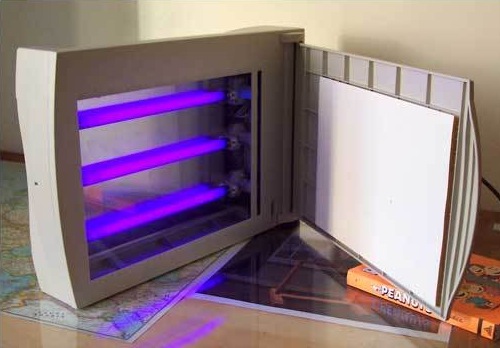
Check out Instructables member 5Volt‘s design for using the chassis of a dead flatbed scanner as a housing for a UV light source. This was conceived for making printed circuit boards, but you could just as easily use it for alternative process printing.
Read instructions at Instructables
US $0.49/roll 35mm 24 exposure colour print film
I know nothing about this film or company and vouch for neither, but UniquePhoto.com are selling 24 exposure rolls of Solo DCF 100 colour negative film for $0.49 per roll, with a minimum order of 10 rolls.
New lens hacking book: Exploring Simple Lenses by John Evans
Now this is WTF I’m talking about!
A very practical book from the author of Adventures with Pinhole and Home-made Cameras
Exploring simple lenses is a truly comprehensive examination of the fascinating world of shooting with single-element lenses. It features twelve main chapters, twelve appendices, and a glossary. Its highly detailed coverage includes an extensive Gallery section, as well as diverse practical topics, such as construction methods, more than 50 lens assembly ‘case histories’, and guidelines on basic and advanced exposure control. More esoteric areas deal with image-formation using non-optical household items, and unconventional lens mounting and focusing techniques.
All the photographs use traditional film-based image-capture, with a wide variety of equipment, including 35mm SLRs, 35mm rangefinder cameras, medium format SLRs, medium format rangefinder cameras and large format cameras.
Supplied with five 100 x 100mm neutral density (ND) filters.
I’m ordering this up for review right now and will report back soon!
Buy Exploring Simple Lenses for US $22 (postage included) from AlternativePhotography.com
Tonopah workshop with Jim Galli and Per Volquartz
Tonopah Nevada, November 12 to 16, 2007
A workshop with Jim Galli and Per Volquartz
Tonopah is an old mining town located in a part of Nevada, which is wide open and full of photo opportunities!
Both Jim Galli and Per Volquartz are seasoned large format photographers who will lead you to great locations, both natural and man made. Among other things you will learn how to scout and work efficiently in deserted locations. Interpretation of a scene, using the zone system, use of equipment, feedback on your personal work (portfolio and prints) and offering information about how to write effective grant proposals are just some of the items covered in this workshop.
Jim’s knowledge of lenses is legendary. Per Volquartz will show you how to analyze and simplify image content of a given location for maximum impact.
FREE – suggested donation = $85.00 per person to cover handouts, access and other workshop related expenses.
Email Per Volquartz to sign up today. The workshop is limited to 17 people.
Please write TONOPAH 2007 in your email header!Email: volquartz@volquartz.com
Per Volquartz website: www.pervolquartz.com/workshops.html
Jim Galli website: tonopahpictures.0catch.com
How to build a $10 visible, IR, and UV light meter
Parts cost around $10.00 US. Gain switch has 5 positions, each an order of magnitude more sensitive from very dim room light to very bright sunlight. (Slight modifications allow extends sensitivity an extra factor of 1000, and neutral density filters can be used for bright light.)
Sensitive from mid-IR to mid-UV. With filters can look only at UV, IR, Visible, individual colours, polarization, etc. Easy to build with tools at home – just use a drill, saw and soldering iron. Works with any cheap multimeter permits quantitative measurements for an enormous number of existing experiments (eg. 1/R 2 law, efficiency of different light sources, polarization of light sources, emission spectra etc.)
Get instructions from directory index, PDF and .doc files available
Via MAKE Blog
The over-educated eye?
Gallery owner Edward Winkleman has an interesting discussion going on at his blog about whether being too well-informed interferes with appreciating/enjoying art.
I’m with Winkleman: I say no. I have no problem blanking my mind and going for the ride. It’s only once the experience has run its course that I may try to figure out why it was the way it was, and it’s just as likely to be influenced by my state at the time as by composition or density range.
Food, on the other hand, is another matter for me. It may be because I’m probably a better pastry chef than I am a photographer, and having spent a large part of my youth in a commercial restaurant kitchen, have spent a lot more time paying attention to the experience of eating than I have to the experience of viewing art, but it’s difficult to go out and enjoy a meal. Dessert? Forget it. 9 times out of 10, I’m not even going to bother. It’s not that I go looking for food to be unenjoyable to boost my ego or anything, I simply can’t help but notice it. It’s like trying to watch a movie in which you can see the crew walking around in the background and the boom mic bobbing up and down at the top of the screen. (Oddly, this happens far less with home-cooked meals than it does at restaurants. Maybe there is something to that whole context thing…)
Who knows, maybe I’ll feel differently when I know more and have more experience looking at art. But for now, it’s not a problem.
BlinkCam: eye-triggered Polaroid 600 hack
Andrew Schneider hacked a Polaroid 600 into a helmet-mounted self-portrait machine that’s triggered by simultaneous blinking by the wearer. Insane? Check. Cool? Check.
Check it out, includes pictures and video.