"Digital Alternatives" digital/alt process workshop, NYC

This 10 week class at ICP in New York City, meets on Fridays from 10am to 1pm starting on February 2nd. It is called Digital Alternatives, but we will be going back and forth between the digital lab and the alternative lab, using all aspects of photography to create work. Paper negatives, digital negatives, historical techniques, transfers and decals so that we can combine photographic skills from the beginnings of photography up to the 21st century. Participants with basic Photoshop skills will learn how to optimize their files using various manipulation techniques. Demonstrations will address subjects from scanning and image editing to the production of the final enlarged digital negative.

The workshops run Fridays 10:00am – 1:00pm, 2 Feb – 6 April, 2007 at the International Center for Photography, New York, NY, US.

About Jill:
Jill Enfield, one of this country’s most experienced and respected handcoloring artists; is a fine art, editorial and commercial photographer. She has taught handcoloring and non-silver techniques at Parsons School of Design, The New School, Fashion Institute of Technology, New York University, Long Island University and the International Center of Photography in New York, as well as in workshops throughout the USA and Europe. Her work is in the collections of RJ Reynolds Co., Southeast Banking Corp., Museo de Arte Moderno de Mediellin in Colombia, The Boca Raton Museum of Art and Hotel Parisi in LaJolla.

Jill’s book on non-silver techniques titled: Photo Imaging: A Complete Guide to Alternative Processes published by Watson-Guptill in November 2002, won the Golden Light Award for Best Technical Book of 2002 through the Maine Photographic Workshop and is already in its second printing.

Nikon has honored Jill by featuring her on their web-site as a "Legend Behind The Lens" photographer as well as in their Full-Line product guide and an upcoming issue of Nikon World. Jill has also appeared on The Today Show Weekend Edition, New York One and The CBS Saturday Morning Edition as a spokesperson for www.takegreatpictures.com on several occasions.

Thanks to Tom Persinger of f295 for the heads up!

DSLRs and pinholes made from film: a match made in heaven

I posted the other day about Roger Cline‘s instructions for making perfect pinholes and zone plates using graphic arts film, which is totally sweet on its own. Repeatable and perfect pinholes? YES!

But wait! There’s more! I just realized that Cline’s method is a huge boon for people who shoot digital. It’s easy and cheap enough to make a pinhole body cap for a DSLR (or you can buy one from holgamods if you’re not the DIY sort), but there is a problem: digital sensors become charged and literally suck in dust like a magnet. Normally it’s a good idea to put some sort of clear filter behind the pinhole to prevent dusty build-up, but this is a cheaper, less complicated, and automatically fixes the problem. No hole to the outside, no dust! Nice!

That photo everyone hates but you

I think everyone’s shot that one photo that everyone hates, or worse, doesn’t respond to at all. Everyone except you, who love it to death and just don’t understand why others fail to see its obvious brilliance. Or at least absence of outright suckage. Sure, there may be some things that would be fair to bring up in an analytical critique, but that doesn’t stop you from just liking the thing.

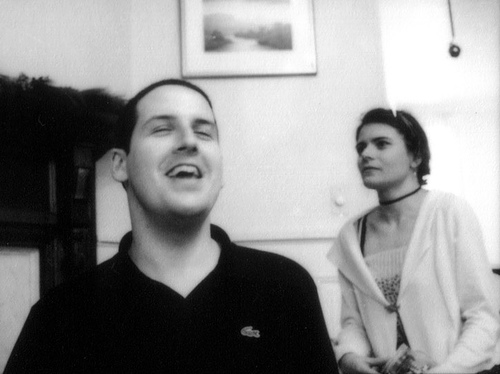
Here’s mine (yes, it looks just the way I want it to, fuzziness, contrast, and all):


My hated photo: Ben and Jen


What’s yours?

(Comments with links in them get held for moderation, so don’t be surprised if your response isn’t visible right away. I’ll be checking the queue regularly, though.)

Thoughts on an untitled photo by Brett Harrington

Untitled by Brett Harrington

Brett Harrington posted this on Flickr a few days ago. After I gave it a minute to sink in, I was all

This is another one of those "everything" images… it’s real and abstract, distant and in your face, cold and inviting. But I think it defies that kind of analysis because almost every observation I can make about it is both true and false. It’s like Schrödinger‘s photo, only you never get to open the box. That whole way of trying to explain or look is totally broken for this, so I can just cast it off to the side and forget it. That in and of itself is both amazing and rare, but after that, it’s still got me by the neck. It hasn’t slid into "well I just don’t get it or know what to make of it then" territory. After all that it’s still relevant, personal, and in an interesting and good way, invasive. But the way in which it is those things is beyond my ability to understand in concrete terms, so you’ll have to make do with "I really, really like this".

and he was all

…this is one of those shots that I don’t know why I like it, but I know I really do. It’s also one of those shots that reminds me of my taste in art. If you could search my deleted tags you would see I was about to tag it, "maybe just for me" due to the punches from nowhere it was giving me. I will stop there, knowing that you have already worded it better than I will if I keep going. I think it’s one of the best shots I have taken in awhile and I am very damn pleased that it has you by the neck.

and it was you know, like, cool and stuff. A week later and it’s still as captivating and description-defying as it was the first time.

John Loomis on portfolio editing pain

Putting together a portfolio of any kind of art is painful. Way more painful than it seems it should be. Photographer John Loomis has some interesting thoughts on the process on his blog:

Even while I fully understand the need to put together an updated portfolio, and it is very important to put new, interesting work out there as often as possible, the process can be so unforgiving that even starting down the path can grind your professional life to a dead stop. More than a few times in the middle of designing a portfolio I’ve basically thrown up my hands and shouted, "holy shit, what am I doing?!" What you are really doing is creating a mirror of your passion and vision of the world you live in, and sometimes that reflection is extremely difficult to see anyway but darkly.

Sounds about right. This process has made me want to burn all my film and think that my pinhole cameras might be put to better use as gravy separators and my lenses used to start fires more times than I can count. There is a reason I haven’t managed to put anything in my gallery section in over a year of the site being up (though that’s about to change), and that is that editing portfolios sucks with a capital SUCKS.

Continue reading at Drinking With a Dead Man

Via Katie Cooke

"Photography Without a Lens: An Artisanal Approach" workshop, NJ, US

Join us for this lively and engaging workshop in which we’ll investigate the artisanal qualities of lensless photography. Participants can expect to discuss the historical and contemporary uses of lensless photography, learn about different camera options and then design and construct a camera to achieve different types of images. Spend time using the camera(s) to make images and developing/printing those images in the darkroom. We’ll also enjoy discussions regarding the counterpoint these "primitive" techniques play in the world of contemporary photography, peer review of participants pinhole work, and how the longer exposures inherent to pinhole work affect both the images and the act of making them.

The workshop runs 8–10 September, 2007 at the Peters Valley Craft Center, 19 Kuhn Rd Layton, NJ, US. It will be run by Tom Persinger, who is an accomplished pinhole camera builder & photographer, runs the f295 Lensless Photography and Alternative and Adapted Process photography fora, is the organiser of the upcoming 2007 Symposium on Lensless, Alternative and Adaptive Photographic Processes, and has written numerous magazine articles on lensless imaging. In short: you’re in good hands!

Skill Levels: Beginner to Advanced
Tuition: $325
Lab Fee: $30

You can register online.

Via Pinhole Visions