Homemade pinholga floppy disc shutter

Will Luo's DIY pinholga floppy disc shutter

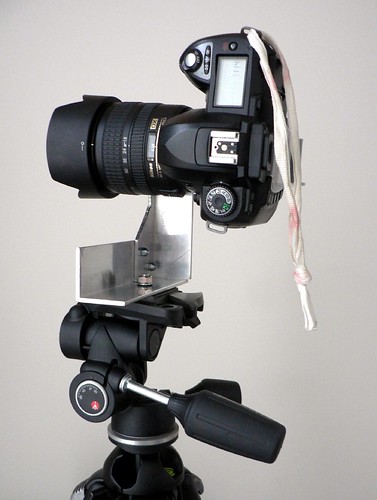
Check out Will Luo‘s sweet 3rd-generation homemade pinholga floppy disc shutter. He writes:

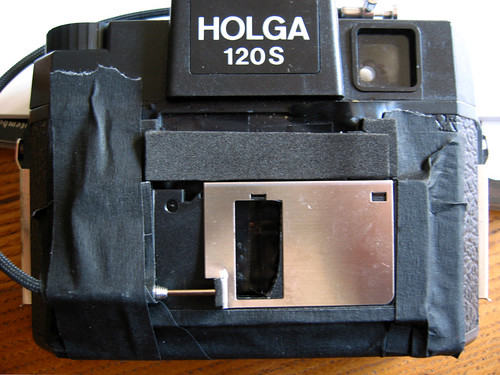
the third incarnation of the pinholga’s shutter. i got the idea of using a floppy disk from this blog entry. this one is customized for the holga though. it was much easier and faster to make than the last version:

1. cut off the part of the disk that has the spring-loaded protector. the disk i got had some soft paper coating inside which i removed as well.

2. make a small cut here and bend the corner up to make a small "handle" that can be used to push the floppy door open. i glued a little piece of foam there to make it less slippery for the cable release…

Continue reading at Luo’s Flickr photostream.
3rd generation Lensbaby locks into position

3rd generation Lensbaby

Lensbabies press release:

3rd Generation Selective Focus SLR Lens Locks in Bent Position, Allows Precision Focusing

Cologne, Germany; Photokina Hall 5.2, Booth D028 (September 26, 2006) – Today Lensbabies, LLC launched its 3rd generation selective focus Single Lens-Reflex (SLR) lens, Lensbaby 3G, introducing new features that dramatically expand the Lensbaby product family’s capabilities.

The Lensbaby 3G SLR lens allows photographers to lock the Lensbaby in a desired bent position simply by pressing a button. Then, using a traditional barrel focus mechanism, photographers can do fine focusing and precisely place the sweet spot of sharp focus before pressing the shutter release. The Original Lensbaby lens and the Lensbaby 2.0 lens require the photographer to manually hold the Lensbaby in a bent position while pressing the shutter release.

Lensbaby selective focus SLR camera lenses take photos with one area in sharp focus, with that ‘sweet spot’ surrounded by graduated blur. Photographers can move the sweet spot of sharp focus anywhere in the photo by bending the flexible lens tubing.

"Response to the Original Lensbaby and Lensbaby 2.0 has been great," said Craig Strong, the inventor of the Lensbaby and Co-Founder of Lensbabies, LLC. "But we asked our customers what new features they wanted. Studio photographers told us they want to repeat Lensbaby photos exactly the same each time, whether they are shooting food, fine art nudes, or Chanel shoes. Studio portrait photographers told us they want greater confidence in the sweet spot’s sharpness and placement. Outdoor and location photographers said they are interested in shooting longer exposures than are possible with the Original Lensbaby and Lensbaby 2.0."

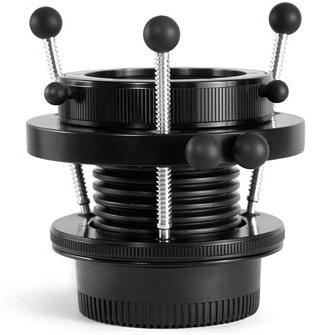
Lensbaby 3G features the same low dispersion, high refractive index, multi-coated optical glass doublet and the same flexible tubing as Lensbaby 2.0, but adds three focusing rails that emerge from the camera mount and pass through the focusing collar. A trigger button on the focusing collar releases three pins that engage the focusing rails and lock Lensbaby 3G in a bent position.

"The process of shooting with Lensbaby 3G is quite different than with Lensbaby 2.0, and the two lenses are optimized for different types of photography. While Lensbaby 2.0 is great for intuitive, fluid, photojournalistic shots, Lensbaby 3G is a workhorse for pros that require precise focusing, complete control, and repeatability," said Strong.

Once Lensbaby 3G is locked into place, additional fine focus can be achieved by turning the barrel focusing ring, which moves the optic in and out like a normal manual focus lens. Also, in the locked position, a photographer can make small adjustments to the placement of the sweet spot of focus by turning any combination of the three focusing rails.

"We think Lensbaby 3G is the logical next step in the evolution of selective focus photography, allowing complete control and repeatability," said Strong. "We hope Lensbaby 3G will meet photographers’ needs for precision while stimulating their creative vision."

Lensbaby 3G SLR lenses will be available starting in mid-October from www.Lensbabies.com, by calling 877-536-7222 / 971-223-5662, and from select specialty photo stores. Lensbaby 3G is initially available in mounts for Canon EF and Nikon F camera bodies. Versions of the Lensbaby 3G for Olympus 4/3rds/Panasonic, Pentax K/Samsung GX, and Sony Alpha/Minolta Maxxum digital and film SLR camera bodies are scheduled to ship in mid-November. Optional accessories include the Lensbaby Macro Kit™. Photographers can also mount a variety of 37mm threaded accessories, such as wide angle and telephoto conversion lenses, onto the front of their Lensbaby.

Unsolicited critique: (Untitled) by Brett Harrington

This is part of a series of unsolicited photo critiques—see introduction.

This untitled photograph is by Brett Harrington (aka S.McKay). This isn’t really a critique or a commentary, because anything I could say about this image would start to define it according to my point of view, and to define it would be to fuck it up. Rather, this is an invitation to look into something else and see something of yourself: what do you see and feel? What does that tell you about your current state, right here and now? Are you willing to truly engage with an image like this? What does that tell you? Have at it.

(Untitled) by Brett Harrington

Susie Linfield on "this treacherous medium called photography"

Put most bluntly, for the past century most photography critics haven’t really liked photographs, or the experience of looking at them, at all. They approach photography—not specific photographs, or specific practitioners, or specific genres, but photography itself—with suspicion, mistrust, anger, and fear.

It is precisely because photos are so confusing—such utter failures at providing answers—that they are so valuable: by refusing to tell us what to feel, and allowing us to feel things we don’t quite understand, they make us dig, and even think, a little deeper.

Read article at Boston Review

Via éclectique

Digital discontent, or, I bitch about Canon

A friend and I went shooting yesterday at a local park. The group behind the park are applying for a grant and wanted some photos for the application, so we grabbed a Canon 20D and a few lenses and set off, thinking that digital’s convenience would be a clear win in terms of delivery speed, and that the camera’s automation would allow them some frustration-free shooting. In short: I hated it.

I don’t shoot a lot of landscapes, and when I do, I usually use a toy camera with film. I’ve probably taken less than 25 landscape shots on the 20D in the year or so I’ve had it, so take all of this with a grain of salt.

I usually only use the DSLR when I really need the strengths of digital, which for me, with this camera, are the ability to shoot a lot without changing recording media very often, speed of getting a digitized image into a computer, ability to shoot a lot without increased cost (with digital, the more you shoot, the lower your per-frame cost is, which is kind of weird), and the ability to make an unlimited number of perfect copies. For me it’s for non-artistic, utility work shooting like events and products, which I normally do indoors with controllable lighting or where there’s a dominant subject.

One thing that really pisses me off about DSLRs in general—I won’t say digital as a whole because I don’t really use digicams and have never even seen a digital medium or large format back—is that they’re still metering for film. Digital is not film, and this ends up being a real problem. Digital needs to be "exposed to the right" to get non-crappy shadows, and this isn’t some hair-splitting, pixel-peeping bullshit, it makes a difference in actual photography. The problem is that the metering on all DSLRs I’ve ever handled or read about don’t take this into account. The result is that if you want a decent image, you have to make an exposure, check your histogram, and re-shoot until it’s right.

LCDs are useless for judging exposure by inspecting the image (which is why I don’t really care about larger screens, I only use them for the menus (ugh) and histograms, and I don’t need more of a battery suck to do it). This means that you have to go by histograms to see what you really have. On the 20D you only get a luminance histogram, which means that you could be clipping one of the color channels and not know. Yes, you do get RGB histograms on the higher-end bodies, but it astounds me that you can pay $1,500 for a digital camera that gives you no way to actually know what you’ve got. To me, this is about 1/3 of the whole point of digital: knowing what you’ve got. You don’t get that on the 20D, you get to wait until you’ve applied another field-unfriendly process to what you’ve captured… just like film. $1,500 in and Polaroids are still the best option.

Right. So, shoot, examine misleading histogram, guess, and re-shoot. Lovely. On top of that, Canon’s matrix metering was utterly atrocious. I had to apply plus or minus two whole stops of exposure compensation to get decent-looking histograms, depending on the lighting conditions. Most of the first exposures of a given scene—the ones shot as metered by the camera—were unusable. Maybe when you shoot JPG instead of RAW, the camera does some fancy processing that fudges it, but I can’t imagine anyone shooting landscapes as metered and not returning the camera immediately.

Bottom line: I got a lot of aggravation, a heap of extra images to wade through, missed lighting while checking histograms, and less predictable and accurate exposures than I do shooting slide film using the sunny 16 rule.

Next time I guess I’ll have to set the camera to bracket as much as it allows and machine gun it. That’s kind of OK for landscape photography in static light. But what about the vast majority of other types of shooting, where you don’t have that luxury? This is progress? This shit doesn’t work for what it’s supposed to do.

Side gripe: I invite anyone at Canon to take a 20D, 30D, or 5D, put a 70-200 2.8L IS lens on it, and frame a handheld shot. With me? Good. Now [attempt to] press the depth of field preview button. I can’t imagine what it must be like with a longer lens. The button really needs to be moved to the grip, under the middle or ring finger. To say nothing of the sustained and at this point literally unbelievable lack of an MLU button.

Moral confusion in photography

Mike Johnston responds to a comment about a daguerreotype of 9/11 that questions the photo’s morality. Interesting read.

The source of the reaction seems simple: ordinary viewers know that to take a photograph you have to be proximate to your subject. Thus, they know that the photographers were "there." And if they were there, the logic seems to go, they should have acted to change the situation, somehow. (It’s partially a wishful "I" statement on the part of the viewer, to wit: "If I had been there, I would have taken action.")

Check it out at The Online Photographer

New Think Tank Photo camera bags

Think Tank Photo has unveiled eight new photo bags and bag accessories aimed at the working shooter and serious weekend photographer. Like previous Think Tank offerings, they feature some of the nicest product design we’ve seen coupled with the company’s usual flair for product naming. Here’s a rundown of what’s new…

Continue reading the complete run-down, with photos, at robgalbraith.com

Via the Open Photography Forums

New Lomo LC-A+

As much as I hate to give any publicity whatsoever to the monopolistic rip-off marketing goons at the Lomographic Society, they have come out with something cool. Like everything else they sell, it’s embarassingly overpriced, and I recommend that you not buy anything from them unless it’s unavailable anywhere else—for example, don’t pay $70 for a $15 Holga, get it from holgamods or Amazon—but this is such a product: the Lomo LC-A+.

Take your standard small, cute, horribly-built, awesomely Minitar-lensed Lomo LC-A 35mm camera, and add a double exposure button, metering up to ISO1600 (why the fuck didn’t they go to 3200 as long as they were in there??), and a standard threaded cable release socket. Take away manual exposure; this is auto-only.

The cheapest way to get this camera from them is the Standard Package, which consists of the camera, Colorsplash flash (just want the camera? too bad), cable release (just want the camera? too bad), "Lomographiere" hardcover book (don’t want to pay them for their own marketing materials? the materials where they use their customer’s photos and don’t pay them? too bad), two rolls of film (just want the camera? too bad!), and a set of batteries (OK, that’s actually useful). All yours for the modest price of US $250.

They’re accepting pre-orders now and say the first batch will ship 2 October, 2006.

Immense shitload of new Zeiss F, M, and CF lenses

Zeiss are blasting out a huge range of new manual focus lenses:

Leica M mount

  • Distagon T* 18mm f/4
  • C Biogon T* 21mm f/4.5

Nikon F mount

  • ZF Distagon T* 35mm f/2
  • ZF Makro-Planar 50mm f/2
  • ZF Makro-Planar 100mm f/2
  • ZF Distagon T* 25mm f/2.8

Hasselblad CF mount (appear to be vintage-look versions of the currently available equivalents)

  • Makro-Planar T* 120mm f/4
  • Distagon T* 50mm f/4
  • Sonnar T* 180mm f/4

Check out Photos and commentary at The Online Photographer or Zeiss’ rundown (minus the Hasselblads).

Via Auspicious Dragon’s photostream blog