The title says it: the Leica and Tamron Web sites have been redesigned.
Author: Nicolai Grossman
Unsolicited critique: Jessica, Tomsu Cleaners by Dan Loflin
This is the first in a series of unsolicited photo critiques (see introduction).
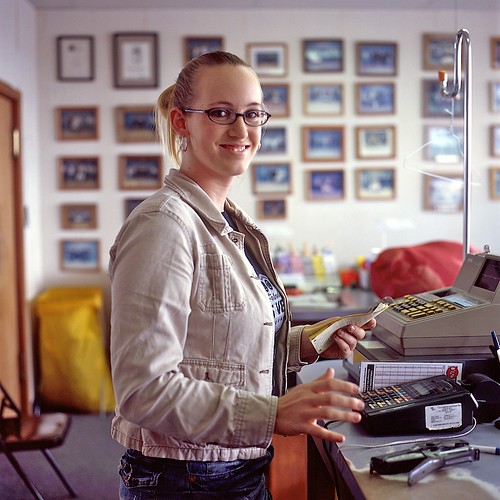
This photo, Jessica, Tomsu Cleaners, is by Dan Loflin. I love this guy’s work, and he’s made heaps of other interesting images, but this is a recent one that grabbed me.
Take a good, long look. This one’s better if you let it unfold yourself.
(Paraphrasing and expanding on the comment I left on the photo on Flickr:)
What I love about this is that it’s creeper weird. I look at it for a while. I see a pretty normal-looking scene, though it’s something you’re more likely to see in person rather than in a photo.
Great lighting.
There’s something a little uncomfortable about the framing. My eye wants to see the camera moved a bit to the right to eliminate the door frame and include the rest of the cash register. Then I’m glad he didn’t do that, because the subtle tension makes it feels like a real, active space that forces me to take in the whole thing rather than allowing me to snap to an immediate and pat parsing of "woman, cash register", making a bunch of assumptions, and walking away.
Great depth of field choice, it really complements the framing by letting each the foreground and background play their parts.
Then it starts to dawn on me: there’s an undercurrent here, a vaguely unsettling but quickly growing feeling. Then it’s a frying pan to the face. I really see her hands for the first time. They’re acting out their own fitful play while the rest of her is trying to go about her business. She seems interrupted, good-humored and maybe a little self-conscious, but her hands seem undeterred. It seems like Loflin’s given us a window into a long continuum of conflict and looks like a disturbingly precise portrait of functional OCD.
To me, this is a very understated but incredibly powerful decisive moment. It’s not necessarily immediately accessible—it wasn’t to me, anyway—but I think that’s part of this photo’s strength. I like art that makes me work for it a little and participate.
In music, there’s the concept of an "envelope", which describes the shape of a sound, and is broken into four components: attack (how quickly a sound reaches its full volume), decay (how much quieter it gets over how long a period), sustain (how long that quieter bit maintains a plateau level), and release (how quickly it fades out). The same applies to flavors in cooking and the emotional experience of looking at art for me. Not something to be quantitatively evaluated and used to judge work, but I’ve found it to be a useful framework for describing the rides, or plot arcs, that these things take me on.
Some photos, mostly those that rely on an effect over actual substance, give it all up too quickly. OK, you cross processed it, shot it with a pinhole or a Lomo, have a really shallow or huge depth of field, have a great tonal range, made a cyanotype, whatever, it makes an immediate and striking impression. But if you’re not saying or creating anything with that stuff beyond the effect, you’ve got nothing left after half a second. It grabs your attention but then doesn’t do anything with it. This is why de-fatted foods taste like shit: fat masks flavor and spreads its release out over a longer period of time. Without the fat, all the flavor compounds are released and processed right at the beginning, giving you a fast initial hit but leaving you a mouthful of tasteless crap to deal with.
There’s no flavorless crap in this photo. It draws me in with good compositional decisions, hintingly unfolds a little, ramps up quickly, punches me in the face, lets me hang out for a minute to put it all together, and then fades out, like having your head inside a struck bell that never quite stops vibrating. Chewing satisfaction goes on and on.
You can see more of Dan’s work at his Web site, DanLoflin.com, and in his photostream on Flickr.
New "feature": unsolicited photo critiques
I’m starting a new "feature" here on Photon Detector: unsolicited photo critiques. Generally, they’ll be of photos that I think work really well. Hopefully I’ll be able to articulate, at least to some degree, what’s successful about them to me, though I may put up the occasional "damn, check this shit out!" just because it’s awesome.
Disclaimers and notes
- Most photos will be from Flickr, whose Terms of Use allow images there to be posted on other sites as long as they link back to the photo’s page on Flickr. Point five under "General Conditions" says:
The Flickr service makes it possible to post images hosted on Flickr to outside websites. This use is accepted (and even encouraged!). However, pages on other websites which display images hosted on flickr.com must provide a link back to Flickr from each photo to its photo page on Flickr.
When posting images not coming from Flickr, I will get the photographer’s permission in advance. I’ll try for Flickr images, too, but if I don’t, just know that I’m not being evil; those are the terms we agree to when we upload work there. I "we" because I have my own stuff there, too, which is of course subject to the same conditions.
- This is all completely subjective—just one person’s opinion at a particular point in time. I may be wrong. I may change my mind at any time. I may still be wrong. You get the idea.
- It’s about the result, not the process. The process is for the photographer, not the viewer. I don’t see "cheating" with Photoshop as a negative or "keeping it real" by coating your own plates as a positive. Likewise, no points added for Leica and none taken away for a webcam. I’m not a purist and I don’t care how you got there. What works for the image works for the image, and what doesn’t, doesn’t.
The only caveat is that if a technique breaks the spell with its heavy-handedness, it usually detracts from my experience of the photo.
- If I do say something negative, I’m genuinely trying to be constructive. I’m also not saying that I could do better.
- If you think I’m not sticking to this, please bust me on it!
- Remember that I have no idea what the photographer was aiming for when making the image, I only know what I see.
- When I look at engaging photos, I have a tendency to go into a kind of borderline fugue state, step into the image as best as I can, and see where it takes me. Some of my comments will undoubtedly make more sense if you try to do the same, or at least know that going in.
- If you leave a comment—and I hope that you do!—play nice. Let’s not turn this into Michael Johnston’s Great Photographers on the Internet. Be constructive and helpful. If you must attack something, attack ideas, not people. Remeber that liking something and recognizing is as effective are completely different things. I will leave comments that are respectful alone, even if they’re not flattering, and will delete any that I deem assholic.
Check out the first critique: Jessica, Tomsu Cleaners by Dan Loflin
Anti-photo hysteria spreads to Oz
Prime Minister John Howard says a ban on taking photographs at a shopping complex in Melbourne is over the top.
Melbourne’s Southgate complex has banned people taking photos as part of heightened security measures.
…
Ms Peck acknowledges that some may say it is a win for those who wish to curb Australia’s freedom but believes the policy is justified.
The article does quote sane people as well:
Liberty Victoria’s president, barrister Brian Walter, says the centre’s concerns about terrorism are unjustified.
"What a load of rubbish. Give us one example in Australia where taking of photography has led to a terrorist attack," he said.
"There’s just none and people take a lot of photos every day, and to suggest that you can somehow make that link in a rational way is absurd," he said.
Continue reading at ABC News Australia.
Via dessabel
Contact photography show at Outrageous Look, NYC
Outrageous Look press release:
BROOKE WILLIAMS says that her work "is intensely personal and always involves using the photographs to make some kind of record of an experience, to try and make memories more permanent. I was never that good at keeping journals, but I do have a photographic record of experiences I’ve had, glasses of OJ I’ve consumed, shoes I’ve owned, cars I’ve driven, etc. This piece, then, can be seen as a visual diary of the various people with whom I’ve come in contact over the past several years. And they range from my closest friends, to colleagues I work with, to the UPS man… The one underlying principle—the only hard and fast rule of the piece besides the format (833 SX70 Polaroids)—is that I have had some kind of interaction or experience with the people that belong to the hands in the photos."
Freud uses the term "isolationism" to refer to the way the thinking mind interferes with the "possibility of successful contact." Williams sees this project as a "way of visually battling my own ego"—hoping to become enriched by the process of forgetting the self in the endless repetitive con- templation of the other. Brooke Williams lives and works in Williamsburg.
TOM BURKE‘s lyrical black & white photographs show us the sublime aspect of everyday objects and places. He lives and works in Tokyo, Japan.
In one of the two pieces by SACHAR MATHIAS, a sculptural transcription of a melody becomes an instrument of its own, while the other offers us a different mode of musical performance. She lives and works in Williamsburg.
The show runs through 17 August, 2006 at Outrageous Look, 103 Broadway, Ground Floor Brooklyn, NY 11211 (J, M, or Z to March or L to Bedford). Gallery hours are Thursday–Monday, 12–6 pm.
I’ve been following Tom Burke’s work on Flickr for a while. I usually stare, drool, try to think of something coherent to say about it, fail, and try to pick my jaw up off the floor. So, you know, I think it’s, like, really good. Check it out.
Wavycam pinhole camera by Steven Taft
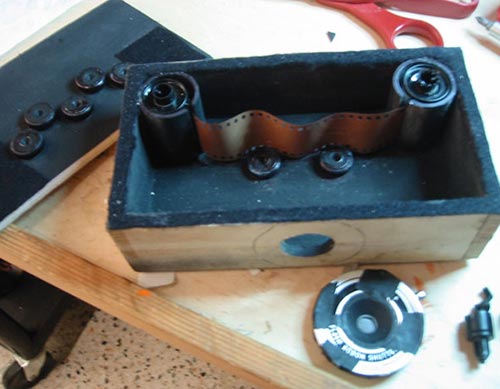
Photographer and camera hacker extraordinaire Steven Taft built this wavy film plane camera. He writes:
…the latest is a "planomorphic" box with shower door rollers to guide the film along several wavy paths. I ran 2 rolls through it yesterday, and discovered a few light leaks and an exposure issue I had worried about. When the film is loaded along a path with deep bends, the single pinhole leaves dark bands down the middle of the image. One solution i had considered before the tests was to go with a multi-aperture system, but i would like to solve it as a single first. I designed this to make the rollers relatively simple to move, so i think i will try placing the film path in more of a convex arc, with the canisters towards the front of the box.
…
…it was never a very reliable/easy camera to use (hard to load, light leaks, film might jump the tracks). New version needed.
Even though the design needs some tweaking, this is a great idea!
See the results and more photos of the camera itself in this thread at f295.
Beautiful new ceramic pinhole camera by Steve Irvine
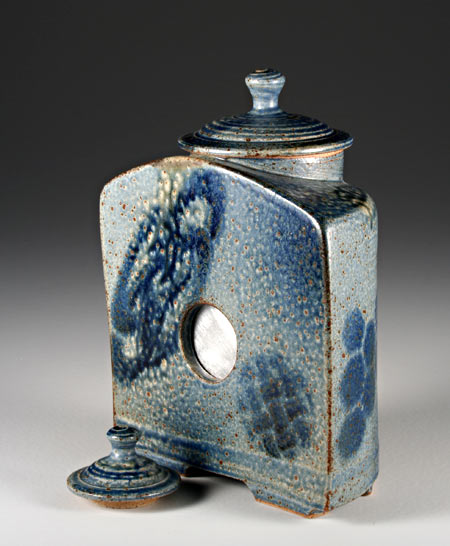
Ceramicist and photographer Steve Irvine has made another dead gorgeous ceramic pinhole camera! Have a look at his pinhole photography, astrophotography, other cameras, and pottery—it’s all exquisite.
Via the f295 Pinhole Photography Forum
Glazer’s Camera pinhole/Holga photo competition
Paul Beard of A Crank’s Progress blog writes:
You’d think they might mention it on their website, but alas, no.
Anyway, they’re running a contest from July 1 to August 12 [2006]. Any Holga or pinhole images is acceptable (need not be a modded Holga—not that that stopped me from grabbing one of their kits: $25 for a Holga, 2 rolls of film, and a few feet of gaffer tape on a 120 spool).
Call Brent @ 206 624 1100 for more info.
Via the f295 Pinhole Forum
Photography masterclass w/ Alan Knowles, Christchurch, NZ
Alan Knowles will give a two-day Masterclass in Christchurch in conjunction with his exhibition, Biscuits, at Canterbury Museum. His presentation will be aimed at photographers with some experience who are working on documentary projects or wish to get into this area. Topics to be covered will include: choosing themes, planning projects, sponsorships and funding, gaining access, obtaining consents, editing the photo essay, negotiating with editors, working with writers, finding a publisher, planning an exhibition, photo agencies, getting paid and annotating and pricing photographs as art.
The Masterclass will be held on Sunday 13 August and Monday 14 August 2006, 9.00 am – 4.30 pm at Level 1 Annex, Canterbury Museum, Rolleston Avenue, Christchurch. The two-day Masterclass will cost $430. Places are limited and bookings are essential. For more information contact Rachel Vavasour, Canterbury Museum’s Education and Public Programmes Manager, telephone 03 366 9429 ext 738 or e-mail rvavasour@canterburymuseum.com
Via GRINZ
Japan Pinhole Photographic Society group show
The Japan Pinhole Photographic Society (JPPS) was founded as an organization in 2005 to promote the art of pinhole photography in Japan. Its purpose is to offer information on pinhole technique and camera making, organize workshops and events, hold informal pinhole photo taking gatherings, and yearly members’ exhibitions.
This event includes the member’s exhibition, a beginners workshop on Saturday, and a symposioum and general meeting on Sunday August 27.
The show runs Wednesday, 23 – Sunday, 27 August, 2006 at Koto-ku "Bunka" Center, 4-11-3, Toyo, Koto-ku, Tokyo, Japan
More info at the JPPS site (in Japanese, though the Gallery link is in English)
Via Pinhole Visions