[Flyer image removed from Flickr]
If you’re unable to see the show in person, check out this preview online. You can see more of his work at his web site, MikePeters.com, and here on Flickr.
[Flyer image removed from Flickr]
If you’re unable to see the show in person, check out this preview online. You can see more of his work at his web site, MikePeters.com, and here on Flickr.
My wife and I were trying to take a picture of both of us together in a sort of co-MySpace fashion: I held the camera out in front of us and she pressed the button. It took a few tries before we got what we wanted, and when we did, we both credited me with it. Which, upon further reflection, really surprises me.
I’ve always considered the photographer or author of a picture the person who pressed the shutter button to make it. Sure, the line can blur a bit with commercial photography or motion pictures, where the final image is the result of large-scale collaboration between art directors, set designers, models, makeup artists, wardrobe consultants, grips, etc., but I don’t shoot like that, so it’s always been fairly clear-cut for me.
It seems that when you get down to actually making the exposure, there are two decisions to be made: where to put the camera, and when to press the button. There are certainly other decisions—lens, film, focus, shutter speed, aperture, etc.—but most or all of those have already been made, or are made for you by automation, before the button is pressed. (We had already selected a Polaroid SLR 680, which has a fixed lens, only takes one kind of film, is auto exposure-only, and we chose to use the auto focus.) Granted, the messed up shots before the keeper were messed up because I aimed the camera badly, not because she hit the shutter at the wrong time, but it seems strange that we both considered it "my" photograph instead of "ours", when we were each responsible for half of the decision-making.
"g." on Polanoid figured out how to make his own Polaroid Chocolate/Sepia peel-apart film! Apparently you need a B&W positive and a color negative… check out these instructions and example shot, very cool!
PolaPremium just released three new, monochromatic, type 100 (3.25 × 4.25 inch / 8.5 × 10.8 cm) peel-apart/pack films. This thread on Flickr says:
These three films were produced by Polaroid employees in the factory in Mexico shortly before the factory was closed forever. Even the packaging was designed by Polaroid employees, making these brand new films 100% Polaroid products, through and through.
100 Chocolate, ISO 80, is apparently the same film as the renowned/smaller/extremely expensive type 80 film of the same name. Run of 30,000 packs that expires October 2009.
100 Blue is ISO 80 and appears to be a full color film, but with a heavy blue cast that looks a lot like expired 669. Run of 15,000 packs that expires April 2009.
100 Sepia is ISO 1500. To me, it’s the most interesting-looking of the films, but at such a weird ISO, it’s probably going to take some fiddling with the exposure compensation dial on most full-frame type 100 cameras, unless you’re lucky enough to have a 180, 190, or 195. Run of 30,000 packs that expires October 2009.
All three cost $16 USD per pack of 10 exposures and are available from the PolaPremium film shop.
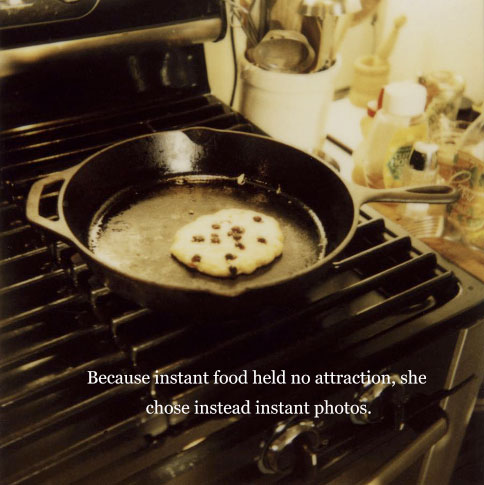
Therese Brown just release a new book, Polaroid Kitchen:
Like a warm, comforting visit, Polaroid Kitchen offers up visual treats and brief anecdotes that celebrate the everyday wonders of food and home. Captured through the unique media of Polaroid cameras and film, these photos provide an intimate glimpse of both the necessity and delights of food.
Having both seen her photos and eaten her food (which is excellent), I expect the book is going to be good! It costs $17.95 – $31.95 USD (depending on binding) and is available immediately through Blurb.
You can see more of Brown’s work at her web site, This Is What I See, and here on Flickr.
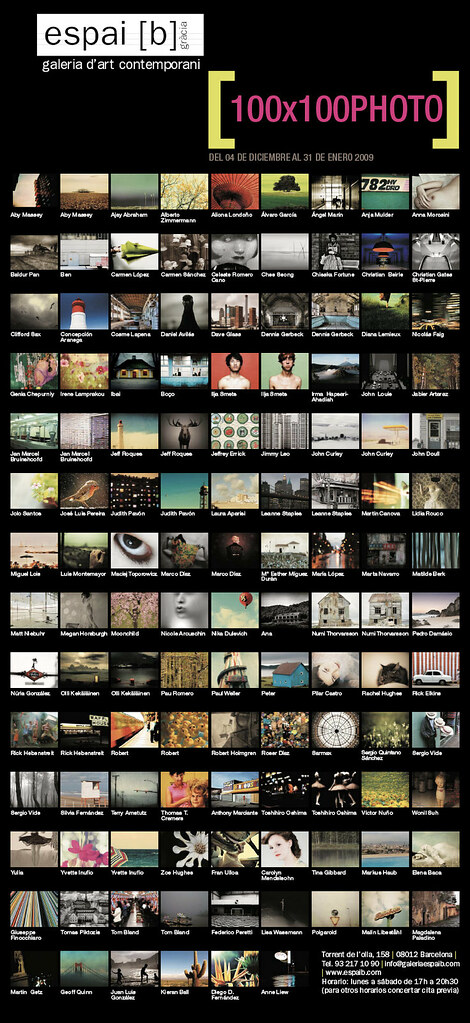
Toshihiro Oshima says:
@espai[b] galeria d’art contemporani in Barcelona/Spain
[100X100PHOTO] starting on December 4!
I’m proud to have 2 of my photos to be selected on this show.The concept of this show is to present 100 photos from 100 photographers, and each photos will be sold for 100 copies/45 euros per each.
PolaPremium just launched their web store with a bunch of out-of-print Polaroid films. Of particular interest are 600 B&W, Artistic TZ, Type 80 Chocolate, and Type 55 Pos/Neg, as well as straight 600, Spectra, a number of peel-apart/pack films, books, vintage cameras, and accessories.
The 600 B&W seems particularly interesting… if you look at the sample shots, the tonal range is almost ambrotype-ish, where the brightest highlights are still quite dark. It’s going fast: the site listed 311 packs in stock when I looked a few hours ago (immediately after the store went live), and it’s already down to 224, so grab it NOW if you want some.
Yes, it’s expensive. And it ships from Europe, so those of us in the States get hit ($25 flat rate) on shipping for a change. But it’s the good stuff, and I’d be surprised if this didn’t do very well, despite the cost, once again casting favorable light on Polaroid’s unique products and horrible light on their business and marketing decisions.
Some big news in instant film is apparently happening in about 3.1 hours, according to the PolaPremium web site, which for now teases us with a countdown timer and the text, "The New Home of Instant Photography".
It appears that there will be new instant films from unsaleable.com, the folks who did SX-70 Blend, indicated both by the rumor mill, and the fact that their site is now just a link to PolaPremium, titled "Transfer in Progress…"
As someone who laments the loss of Polaroid integral films on a daily basis, I’m waiting with baited breath!
Check PolaPremium.com and the PolaPremium group on Flickr to see what happens.
According to this press release, Fuji is finally bringing their integral instant film (sorta similar to Polaroid 600 and Spectra) to the US. Here’s the meat of it:
"In recent months, as availability of instant film has dwindled, we’ve received inquiries from customers in a range of markets here in the U.S. including health care, law enforcement, insurance, real estate, and others, who really need to continue using a traditional instant film solution" said Christian Fridholm, vice president of marketing, consumables, Imaging Division, FUJIFILM U.S.A. "We believe that people familiar with instant photography, but who are new to the Fujifilm Instax brand, will be impressed with the intuitive design of the Instax 200, and will be especially pleased with the vivid colors and bright whites delivered by our Instax Instant Color Film."
The Instax 200 and Instax Instant Color Film will begin shipping in late December and will be available for purchase through Fujifilm’s professional dealer network. MSRP for the Instax 200 is $69.99 and a 20-pack of Instax Instant Color Film is $28.99.
…
The Fujifilm Instax System offers an appealing alternative to previous users of Polaroid cameras utilizing Polaroid Type 600 Films…
$28.99 for 20 shots is on the high side, but I’ve seen it cheaper online from several Canadian resellers.
For more info, check out Fujifilm USA’s Instax web page and Instax system PDF data sheet.
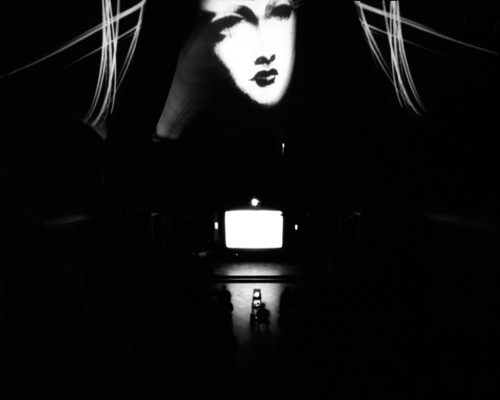
Thomas Graichen is having a show of mostly pinhole and long-exposure photography as part of the 3rd European Month of Photography Berlin. He writes:
If you are in or near Berlin (Germany), I would like to invite you to my second solo exhibition called “An der Grenze des Lichts” (“The Liminality of Light”), which is a part of the 3rd European Month of Photography Berlin. The exhibition is spread across two locations in Berlin: the Galerie RS21 Berlin and the Babylon Berlin Mitte. Most of the images were created using pinhole cameras and/or long time exposures.
The first part of the exhibition will open on saturday 8th of november [2008] at 7pm at Galerie RS21 Berlin and the second part on tuesday 11th of november at 6pm at Babylon Berlin Mitte. More information about the exhibition and some sample images can be found here and at the pages of the 3rd European Month of Photography Berlin (see also here
and here)
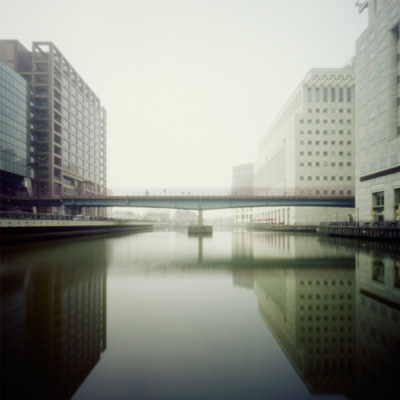
Both Graichen’s work and the Month of Photography in general look very interesting, so if you’re near Berlin, check it out! You can see more of Graichen’s work at his web site, meer-berlin.org.
Photographs © copyright Thomas Graichen. Used with permission.