To know ahead of time what you’re looking for means you’re then only photographing your own preconceptions, which is very limiting.
— Dorothea Lange (via Blurry Thinking)
To know ahead of time what you’re looking for means you’re then only photographing your own preconceptions, which is very limiting.
— Dorothea Lange (via Blurry Thinking)
Here’s the abstract of a paper by Anat Levin, Dani Lischinski, and Yair Weiss:
Colorization is a computer-assisted process of adding color to a monochrome image or movie. The process typically involves segmenting images into regions and tracking these regions across image sequences. Neither of these tasks can be performed reliably in practice; consequently, colorization requires considerable user intervention and remains a tedious, time-consuming, and expensive task.
In this paper we present a simple colorization method that requires neither precise image segmentation, nor accurate region tracking. Our method is based on a simple premise: neighboring pixels in space-time that have similar intensities should have similar colors. We formalize this premise using a quadratic cost function and obtain an optimization problem that can be solved efficiently using standard techniques. In our approach an artist only needs to annotate the image with a few color scribbles, and the indicated colors are automatically propagated in both space and time to produce a fully colorized image or sequence. We demonstrate that high quality colorizations of stills and movie clips may be obtained from a relatively modest amount of user input.
Both the interface and the results are rather amazing. Tons of examples and Matlab source code included.
Kodak’s film discontinuance notice says:
KODAK is preannouncing the discontinuance of several smaller running families of Professional film – EPR, EPN and High Speed Infrared (HIE) effective end of December 2007. Demand for these products has been declining significantly in recent years, and it is no longer practical to continue to manufacture given the low volume, the age of the product formulations and the complexity of the processes involved.
We will continue to ship product through the end of this year.
These discontinuances are effective in all countries worldwide, with one exception: KODAK PROFESSIONAL EKTACHROME 64 Film / EPR will continue to ship to Japan beyond 2007.
The suggested replacement for KODAK PROFESSIONAL EKTACHROME 64 Film / EPR is
KODAK PROFESSIONAL EKTACHROME Film E100G or E100GX.The suggested replacement for KODAK PROFESSIONAL EKTACHROME 100 Film / EPN is KODAK PROFESSIONAL EKTACHROME Film E100G or
KODAK PROFESSIONAL EKTACHROME 100 Plus Film / EPP.
Ektachrome 64 will probably still be available through Megaperls Webshop (at greater cost, of course), who sell Japan-only film photo products to the rest of the world.

The latest in the Exposure.Detroit series of photo exhibitions opens Friday, 9 November, 2007. Check it out!
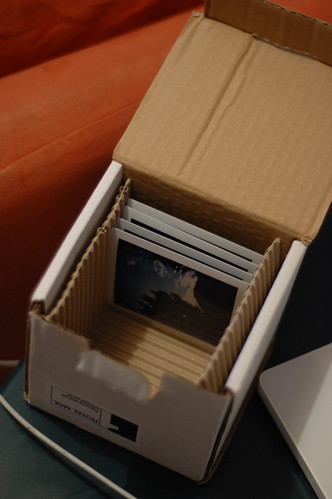
Dealing with Polaroid peel-apart film in the field is a bit of a pain, because once you peel it, you need to think of something to do with the print, and protect it from dust, bugs, and dirt, whilst it dries. Some of them are pretty fast, but some, like 669, seem to take ages. This is why I seldom shoot pack film out and about, it’s just too cumbersome.
As you can see above, David D solved this problem elegantly and cheaply. Sweet, I can’t wait to try this!
This is from month or two back, I somehow got it stuck as a draft and forgot about it. Anyway, the following large format lenses are now out of production, so whatever is left in the supply chain is it if you want to buy new:
and all of the Hasselblad XPan/Fuji TX lenses stopped shipping in November 2006:
Via Kerry L. Thalmann on the Large Format Photography Forum
If you’re interested in Fujinon large format lenses, check out Thalmann’s Unofficial Fujinon Lenses page. No historical information seems to be available from the manufacturer, and this is far and away the best resource I’ve seen.
Following the story of one of Polaroid’s coating plants closing reported by South Coast Today, several message boards have been alight with rumours that Type 55 positive/negative sheet film is discontinued.
Bill Schwab (who BTW makes fantastic pictures) actually bothered to call Polaroid, and said:
Just got off the phone with Polaroid (easy) where I was told that Type 55 is FAR from dead. In fact I am told sales are quite strong and consistant. I was told there are several coating facilities. I am now forwarding the article David linked to because they did not know of these rumours and want to read them before commenting further.
Check them facts, y’all. Picking up the phone before feeding the fire isn’t hard, it’s responsible. Of course the company may lie to you, but at least you’ve done some due diligence.
Did Levi Hill invent colour photography in upstate New York in 1850? Radio programme All Things Considered takes a look:
The Smithsonian is tackling one of the biggest mysteries in the history of photography — whether color photography was first invented by an American minister from Westkill, N.Y. His contemporaries called his work a fraud, but a new analysis suggests that the story is not that simple.
Listen to the segment online at NPR (requires Real Media Player or Windows Media Player)
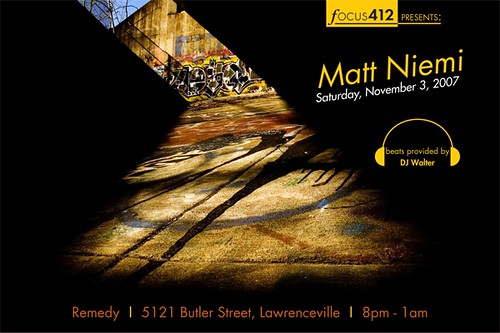
Ten pieces by Matt Neimi sounds like a no-brainer to me!
I think it would be interesting to be dropped off someplace completely foreign (not knowing where I’m going ahead of time), shoot all day, have my memory of it wiped, and then look at what I shot. Kind of like Winogrand—who waited a few years before processing and printing his exposures so he’d have no distinct memory of making them—plus.