

Check out this insane home-built paper cardboard SLR with interchangeable lenses and waist-level finder by Alexander Domotenko! There are heaps of videos at the main project page and photos he’s made with in in this set on Flickr.
Too cool!
Check out this insane home-built paper cardboard SLR with interchangeable lenses and waist-level finder by Alexander Domotenko! There are heaps of videos at the main project page and photos he’s made with in in this set on Flickr.
Too cool!
This is bizarre:
This picture of a patient who had alkaptonuria (Fig. 1) was taken by my father, Dr. Ian Maxwell, in 1957 and was developed using the patient’s own urine [emphasis added].
Alkaptonuria was the first described “inborn error of metabolism.” This rare (< 1 per 250 000 births) hereditary recessive disorder is characterized by a triad of excretion of homogentisic acid in the urine, ochronosis (dark pigmentation of the connective tissues) and early-onset arthritis…
Continue reading and see urine-developed photo in the Canadian Medical Association Journal
Via f295 DIY Photography Forum member taco
This captivating exhibition is the result of several months work by a group of Rio [de Janeiro, Brazil] Street Children who were given cameras and encouraged to express and document their lives through photography. Inspired by the idea of recording moments, for their beauty and excitement, rather than trying to forget, the children have produced a breathtaking body of work. The pictures that followed tell a tale of a city that is at once magnificent and violent, musical, passionate and brimming with color. But the photographers also portray the city and themselves in a sensitive light – asking questions of a community that is trying hard to come to terms with its own prejudices.
It will stand as testament to what the children have produced, an achievement all the more remarkable given their personal backgrounds. We hope the exhibition will truly inform our audience as much about the harsh reality of these children’s lives as about their genuine creativity, undeterminable spirit and the real potential for social change. In collaboration with LAB. Exhibition runs until 23 June [2006].
Shooting Rio opens in London on 15 June [2006] at Canning House in Belgrave Square, London, UK.
The BBC has a preview of photos from the show at bbc.co.uk.
Via Rio photographer Rodrigo Perez
"How to make an (electrical) cable release for the Canon Digital Rebel and how to trip the camera’s shutter with your computer’s serial port. Applicable also to some other Canons (e.g., Digital Rebel XT)."
Read instructions at Covington Innovations
Via MAKE Blog

Check out the Summer Salon group photography show featuring work by Flickr members seawallrunner, sharply_done, and dooda (among others). It runs from 17–25 June, 2006 at Exposure Gallery, 851 Beatty Street, Vancouver, B.C., Canada
Digital Photography Review write:
Leica has announced that all new M system lenses will carry a new 6-bit code (painted in black/white dots) which will allow the upcoming digital M camera to identify which len is being used (up to 64 in 6-bit coding) and also to store this information in image metadata. As well as applying this coding to new lenses Leica has announced an upgrade service which allows owners of existing M series lenses to have the coding written onto each lens at a cost of 95 EUROs. The press release also hints that the new M series digital will appear in the second half of 2006 (at Photokina no doubt).
Wow, only 95 EUR (US $120 as of today) for six dots of paint? That’s a mere 16 EUR/US $20 each! It must be because they "are fabricated with unequaled mechanical and optical precision" and "have an extraordinary aura that can evoke feelings and emotions" like the rest of their range. (Sorry, but how seriously can you really take a company that have a "Leica Mythology" section on their web site?)
Here’s the press release (PDF):
Leica Camera AG, Solms will be giving the lenses of the Leica rangefinder system a new code on the bayonet ring in future to enable the planned digital Leica M camera to recognize the lens type. The information on the lens that is being used helps the camera to optimize image quality. All lenses leaving the factory from July 1st, 2006 onwards will have the new coding, although they can still be fully used with the current analog cameras LEICA MP and LEICA M7 as well as classic models built after 1954. Lenses in the current range as well as many earlier models can be retrofitted at the cost of the owner to benefit from the image optimization in the camera. The lenses are compatible with the planned digital M camera even without retrofitting, except that the additional features cannot be used.
The lens coding is called ‘6-bit coding’ because six fields in the bayonet ring are marked in black or white to represent a number from 1 to 64 in binary code. The planned digital M camera reads this information optically and can identify the lens on the basis of this code. Apart from the improvement in image quality, this information is also written into the EXIF image file.
"On account of their legendary quality, nearly all Leica M lenses are ideal for digital use. However, the new 6-bit coding also uses the performance reserves in the image processing of the camera to give our customers the excellent image result they expect from Leica," says Rainer Bültert, product manager for the M system at Leica Camera AG.
Lenses bought in the past will be converted at the request of the customer for 95 euros at the Customer Service of Leica Camera AG in Solms or the Leica agencies of other countries.
Many of the lenses made from 1963 onwards can be converted. A list of such models is available on the following pages or from the Leica Info-Service (Tel. 06442/208-111). The only lens in the current range that will not be given a 6-bit coding is the LEICA APO-TELYT-M 135 mm f/3.4. It is not codable later, either, as its extension factor of 1.33 makes it unsuitable for use on the planned digital M camera. The launch of the digital Leica rangefinder camera is planned for the second half of 2006.
List of present lenses that can be updated
Name Color Order no. Delivered from Elmarit-M 21mm f/2.8 ASPH. Black 11135 1997 Summicron-M 28mm f/2 ASPH. Black 11604 2000 Summilux-M 35mm f/1.4 ASPH. Black 11874 1994 Summicron-M 35mm f/2 ASPH. Silver 11882 1996 Summilux-M 50mm f/1.4 ASPH. Black 11891 2004 Summicron-M 50mm f/2 Black 11826 1994 Elmar-M 50mm f/2.8 Black 11831 1995 Summilux-M 75mm f/1.4 Black 11810 1998 Apo-Summicron-M 90mm f/2 ASPH. Black 11884 1998 Macro-Elmar-M 90mm f/4 Black 11633 2002 Macro-Adapter M Black 14409 2002 Discontinued lenses that can be updated
Besides those presently available, even lenses that were discontinued quite a while ago can be updated (see list below). Since Leica Camera AG regards system compatibility as a vital virtue, many lenses introduced as long ago as 1963 can be updated.
Name Color Order No. Delivered from-until Elmarit-M 21mm f/2.8 Black 11134 1980-1997 Elmarit-M 21mm f/2.8 ASPH. Silver 11897 1997-2004 Elmarit-M 24mm f/2.8 ASPH. Silver 11898 1996-2005 Elmarit-M 28mm f/2.8 Black 11804 1979-1992 Elmarit-M 28mm f/2.8 Black 11809 1992-2005 Tri-Elmar-M 28-35-50mm f/4 ASPH. Black 11890 1998-2000 Tri-Elmar-M 28-35-50mm f/4 ASPH. Silver 11894 1999-2000 Summilux-M 35mm f/1.4 ASPH. Silver 11883 1994-2004 Summicron-M 35mm f/2 Black 11310 1979-1996 Summicron-M 35mm f/2 Silver 11311 1993-1996 Noctilux-M 50mm f/1.0 Black 11821 1975-1994 Summilux-M 50mm f/1.4 Black 11868 1992-2004 Summilux-M 50mm f/1.4 Silver 11856 1992-2004 Summicron-M 50mm f/2 Black 11817 1969-1979 Summicron-M 50mm f/2 Black 11819 1979-1994 Summicron-M 50mm f/2 Silver 11825 1992-1994 Summilux-M 75mm f/1.4 Black 11814 1980-1982 Summilux-M 75mm f/1.4 Black 11815 1982-1998 Summicron-M 90mm f/2 Black 11136 1980-1989 Summicron-M 90mm f/2 Silver 11137 1993-1989 Apo-Summicron-M 90mm f/2 ASPH. Silver 11885 2002-2004 Tele-Elmarit-M 90mm f/2.8 Black 11800 1973-1989 Elmarit-M 90mm f/2.8 Silver 11808 1997-2004 Elmarit-M 135mm f/2.8 Black 11829 1963-1997 Please ask either your authorized Leica dealer or Customer Service in Solms to perform the update. The latter will be happy to inform you on this subject. Customer Service is available under the phone number +49 (0)6442 208-189.
Thomas Hawk writes:
Today, aqui-ali (another local Flickr photographer), helveticaneue (in from out of town) and I went out to do a bit of shooting. Since Aqui had a meeting down on 2nd Street later this afternoon we decided to head that way and shoot the Transbay Terminal. 45 Fremont was in our path and we were shooting some photos of it as we were walking by. It was then that the security guard there told us that we could not shoot the building. When I explained that we were in a public area and had a right to shoot the building he insisted and called another security guard over on his radio who also tried to get us to stop taking pictures of the building. I still refused as it is my right to shoot buildings in San Francisco from a public area.
Continue reading at Thomas Hawk’s Digital Connection
Via Digg
BetterScanning.com, maker of the well-received "MF Film Holderä" medium format film holder for flatbed scanners, has just released an adjustable height version.
Why adjustable height? The focus of most flatbeds (the Epson Rs, anyway) is supposed to be set at 1mm above the glass for scanning transparencies, but in reality, the true focal point can be off by as much as 250% or more, which means that depending on your scanner, you can get blurry scans with Epson’s crappy stock film holders no matter what you do. "Variable Height Versions allow you to customize the film suspension height to best match your scanner’s particular optics for better focus. It is like adding a focus adjustment function to your scanner."
I had the pleasure of beta testing the dual channel model for Epson 4870 and 4990s, and the difference was substantial. First, it actually holds the film flat, unlike Epson’s holders; second, by following the simple calibration instructions, I discovered that the focus point of my scanner is at 1.8mm, not 1mm, and that my 4990 is capable of better scans with a properly adjusted Better Scanning holder than I was getting with the Epson holder.
I’m travelling right now and will post a detailed review when I get home, but the bottom line is that this is a well designed, well built, fairly priced holder that does what it says, and is sold by a company that stands behind its products. I’m buying the unit I was sent for testing—there’s no way I’m going back to Epson’s junk holder now—and I enthusiastically recommend it.
Check it out at BetterScanning.com
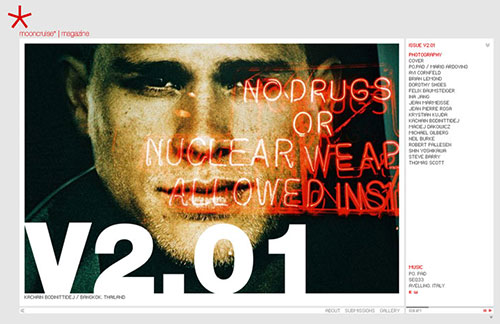
The June 2006 issue (Vol 2, Issue 1) of mooncruise*, an online magazine featuring photography and music by international artists, is now up and ready for viewing.
PHOTOGRAPHY by: po-pad / Mario Ardovino, Avi Cornfeld, Brian Lemond, Dorothy-Shoes, Felix Baumsteiger, Ina Jang, Jean Marmeisse, Jean-Pierre Rosa, Krystian Kujda, Kachain Bodinittidej, Maciej Dakowicz, Neil Burke, Robert Pallesen, Shin Yoshikawa, Steve Barry, Thomas Scott
MUSIC by: po-pad / Mario Ardovino
mooncruise.com (requires Flash 8)
mooncruise* | gallery is accepting international submissions for “PLASTIC” a group show of photography created with toy cameras.
Jens Almström writes:
When I opened my bike’s bell and examined it, I realized that the screw that held the upper half in place had the same dimensions as my tripod’s screw for the camera. Now my bell doubles as a simple camera mount.
Read tutorial at jensalmstrom.se
Via MAKE Blog