Horseman SW-D Pro super wide angle camera

Direct Source Marketing (DSM) Press Release:

CONCORD, CA, June 22, 2006 – A joint venture between Rolleiflex and Horseman today announced one of the widest angle cameras on the market, Horseman SW-D Pro, which accepts digital camera backs to give professional and high-end consumer photographers wide angle opportunities that weren’t available in the past for medium format digital photography. Some of the possibilities not generally accessible for medium format digital photography in the past include super wide angle lenses and bellows-like movements.

Super Wide Angle Lens

Super wide angle lenses were not commonly usable with digital camera backs in the past, because of physical limitations of the camera body. But now, with the Horseman’s new design, you can use a 24mm lens unit with any digital back equipped with a Hasselblad V® mount.

The 24mm lens unit in combination with a 38 x 48mm image sensor provides the same angle of view as a 17mm lens with the 35mm format. This super wide angle is especially useful in interior architecture and landscape photography, but there are many other applications.

The Horseman SW-D Pro lens units come quipped with German Schneider and Rodenstock digital lenses. The shortest focal length, the Schneider Apo-Digitar XL24, is one of four available lens units that include Rodenstock Apo-Sironar digital lenses of 35, 45 and 55mm focal lengths. Horseman SW series (originally for film cameras) lenses can also be used.

All of the available lenses are optimized for digital demands, which mean a smaller image circle with high optical resolution and contrast. This is important because for digital photography, lenses are designed to provide optimum MTF at relatively wide apertures since resolution of the digital image drops visibly at stopped-down apertures (f-stops).

Control of Movement

The Horseman SW-D Pro gives you the freedom of bellows-like movements and adjustments for work that benefits from rise, fall or image plane shift… Maximum rise and fall are 17mm in either direction or (with a 24mm lens unit), 10mm. Sideward shift of the image plane is possible by 15mm in either left or right direction. By combining shift with several exposures, images can be "stitched", resulting in maximum image sizes of up to 48 x 66mm or 36 x 78mm (depending on image sensor orientation). For professionals, being able to manipulate camera movement can make all the difference in sharpness and photo quality.

Franke & Heidecke, manufacturer of the Rollei medium format camera in Germany, and Komamura (Horseman), a leading manufacturer of medium and large format cameras in Japan, announced in February their joint venture to distribute their medium and large format professional cameras in the U.S. through Komamura and doing business as Direct Source Marketing. DSM was created as a result of the joint venture between Komamura Corporation, a long time distributor of Rollei and Horseman products in Japan, and Franke & Heidecke, the Germany-based manufacturer of Rollei products.

The Horseman SW-D Pro is currently available from leading high-end retailers. For more information, go to www.dsmww.com

Suggested retail for the camera is $2,799. Lens pricing is $3,899 for the 24mm lens with APO-DIGITAR 24/5.6; $2,499 for the 35mm lens with the APO-SIRONAR-DIGITAL 35/4.5; $2,599.for the 45mm lens with the APO-SIRONAR-DIGITAL 45/4.5; and $2,599 for the 55MM lens with the APO-SIRONAR-DIGITAL 55/4.5.

Via PhotographyBLOG

Canon PROGRAPH iPF5000 printer review at The Luminous Landscape

Michael Reichmann at The Luminous Landscape has just posted a review of Canon’s new iPF5000 inkjet printer. This is of partcicluar interest because Epson has been the only game in town for fine art photographic printing until this March, when Canon and HP both announced their own offerings at this years PMA trade show. Now that there’s some competition, let’s see how they stack up!

Reichmann writes:

In May, 2006 Canon began shipping the iPF5000 printer. This is a 12 ink, pigment-based, 17″ carriage photographic printer capable of printing in 16 bit mode. It is physically large, moderately priced (for what it does), and, as will be seen, surpasses just about every other fine-art inkjet printer yet available, in terms of both image quality and convenience of features.

This review is based on three weeks of almost daily use of the iPF5000. By way of background, over the past 10 years I have been using a range of Epson printers, including, most recently, the Pro 5500, 4000, and 4800 models. These, especially the current Epson Pro 4800 model, will be my points of comparison.

Continue reading at The Luminous Landscape

Weird pinhole camera roundup

Chris Keeney's Spamera pinhole camera

The great thing about making cameras is that they’re really dead simple: box + light detector (film or sensor) + hold for light = camera. When there’s no lens involved, there’s heaps of room for creativity. While many people opt for more traditional materials like wood, metal, foamcore, or modify an existing camera, some people go all out.

Here’s a [doubtless incomplete] roundup of some of the stranger things I’ve seen people make pinhole cameras out of, to date. Note that many of these links have construction instructions!

If you’re looking to build your own, f295 Lensless Photography Discussion Forum is a great resource full of freakishly helpful camera hackers.

Know of anything I missed? Tell us!

Canon EF 24-105mm f/4L IS USM Lens review at CameraLabs

The lens performed well across its range, particularly in terms of corner sharpness at wide angle, while essentially matching our EF 85mm f1.8 prime in terms of resolving power. We were also impressed with the Image Stabilisation which allowed us to handhold at much slower shutter speeds than normal. Compared to lenses designed for bodies with smaller sensors though, it suffered from a worse degree of light fall-off, but this is par for the course for wide-angle lenses designed for full-frame bodies.

There’s an effective demonstration of Canon’s IS (Image Stabilisation) handheld at 1/13 second, too. (The shit works!)

Read review at Camera Labs

Via PhotographyBLOG

See also: Bill Caulfeild-Browne’s A Comparison of the new Canon 24-105 mm f4 L IS lens with the Canon 24-70 mm f2.8 L and Mark D. Segal’s How I Decided to Up-Grade From a Canon 28~135 IS to a Canon 24~105 F/4L IS at Luminous Landscape

Pinhole photography issue of Black and White Photography Magazine

The July 2006 issue of B&W Black and White Photography Magazine is dedicated to pinhole photography! It features work by Katie Cooke and several members of the f295 Pinhole Photography Forum (among others), as well as four articles on pinhole photography. Ms. Cooke’s work alone is worth the price of the issue and there’s lots of other talent in there, so check it out!

Device blocks non-SLR digital cameras

Georgia Institute of Technology press release:

Newswise — Researchers at the Georgia Institute of Technology have completed a prototype device that can block digital-camera function in a given area. Commercial versions of the technology could be used to stymie unwanted use of video or still cameras.

The prototype device, produced by a team in the Interactive and Intelligent Computing division of the Georgia Tech College of Computing (COC), uses off-the-shelf equipment – camera-mounted sensors, lighting equipment, a projector and a computer—to scan for, find and neutralize digital cameras. The system works by looking for the reflectivity and shape of the image-producing sensors used in digital cameras. Gregory Abowd, an associate professor leading the project, says the new camera-neutralizing technology shows commercial promise in two principal fields – protecting limited areas against clandestine photography or stopping video copying in larger areas such as theaters.

"We’re at a point right now where the prototype we have developed could lead to products for markets that have a small, critical area to protect," Abowd said. "Then we’re also looking to do additional research that could increase the protected area for one of our more interesting clients, the motion picture industry."

Abowd said the small-area product could prevent espionage photography in government buildings, industrial settings or trade shows. It could also be used in business settings—for instance, to stop amateur photography where shopping-mall-Santa pictures are being taken.

James Clawson, a research technician on Abowd’s prototype team, said preventing movie copying could be a major application for camera-blocking technology.

"Movie piracy is a $3 billion-a-year problem," Clawson maintains—a problem said to be especially acute in Asia. "If someone videotapes a movie in a theater and then puts it up on the web that night or burns half a million copies to sell on the street – then the movie industry has lost a lot of in-theater revenue."

Moreover, movie theaters are likely to be a good setting for camera-blocking technology, said Jay Summet, a research assistant who is also working on the prototype. A camera’s image sensor—called a CCD—is retroreflective, which means it sends light back directly to its origin rather than scattering it. Retroreflections would probably make it relatively easy to detect and identify video cameras in a darkened theater.

The current prototype uses visible light and two cameras to find CCDs, but a future commercial system might use invisible infrared lasers and photo-detecting transistors to scan for contraband cameras. Once such a system found a suspicious spot, it would feed information on the reflection’s properties to a computer for a determination.

"The biggest problem is making sure we don’t get false positives from, say, a large shiny earring," said Summet. "We need to make our system work well enough so that it can find a dot, then test to see if it’s reflective, then see if it’s retroreflective, and then test to see if it’s the right shape."

Once a scanning laser and photodetector located a video camera, the system would flash a thin beam of visible white light directly at the CCD. This beam – possibly a laser in a commercial version – would overwhelm the target camera with light, rendering recorded video unusable. Researchers say that energy levels used to neutralize cameras would be low enough to preclude any health risks to the operator.

Still camera neutralization in small areas also shows near-term commercial promise, Abowd said. Despite ambient light levels far higher than in a theater, still cameras at a trade show or a mall should be fairly easy to detect, he said. That’s because image sensors in most cell phones and digital cameras are placed close to the lens, making them easier to spot than the deeper-set sensors of video cameras.

Camera neutralization’s potential has helped bring it under the wing of VentureLab, a Georgia Tech group that assists fledgling companies through the critical feasibility and first-funding phases. Operating under the name DominINC, Abowd’s company has already received a Phase 1 grant from the Georgia Research Alliance (GRA) with VentureLab assistance.

Abowd said that funding availability will likely decide which technology—small- or large-area—will be developed first. DominINC will apply soon for GRA Phase 2 money, Abowd said. Those funds would be used to aid anti-piracy product development, as would any funding coming from the film industry.

Other potential funding, from industry and elsewhere, would likely be used to develop anti-espionage small-area applications.

Stephen Fleming, Georgia Tech’s chief commercialization officer, said motion-picture groups are actively looking for technology to foil piracy. Movie distributors might even promote camera-neutralizing systems by refusing to send films to theaters that don’t install anti-piracy systems.

There are some caveats, according to Summet. Current camera-neutralizing technology may never work against single-lens-reflex cameras, which use a folding-mirror viewing system that effectively masks its CCD except when a photo is actually being taken. Moreover, anti-digital techniques don’t work on conventional film cameras because they have no image sensor.

Good computer analysis will be the heart of effective camera blocking, Summet believes.

"Most of the major work that we have left involves algorithmic development," he said. "False positives will eliminated by making a system with fast, efficient computing."

Also involved in the camera-neutralizing project are Shwetak Patel, a College of Computing PhD student; Khai Truong, a former Georgia Tech PhD student who is now at the University of Toronto, and Kent Lyons, a College of Computing post-doctoral student. A paper on this technology was published and presented at the Ubicomp 2005 conference in Tokyo, Japan, last September.

Via PhotographyBLOG

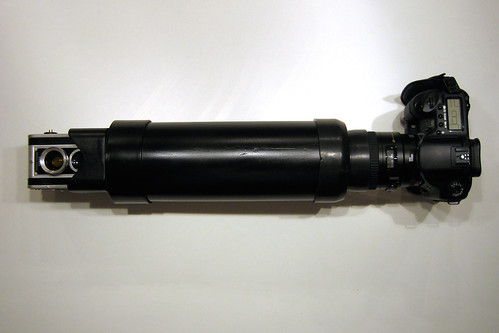
Frankenflex homebrew viewfinder photography rig

Grant Hamilton's Frankenflex

Grant Hamilton built this rig to shoot the image on the viewfinder of his Kodak Duaflex. This is genius and pisses on all other efforts I’ve seen, my own included. He’s making some beautiful images with it, too!

He writes:

See the notes above [on the Flickr photo page] for a parts list. I used a Dremel tool to carve some slots in the side of the junction box to accept the film winding knob and neck strap anchors of the Duaflex. I also carved an opening in the front so the lens is unobstructed. The PVC pipe fits into the junction box with friction and the downspout sleeve is rubber and is fricition fit as well. I painted the whole thing with flat black paint and used varying thicknesses of adhesive furniture sliders inside the junction box so that the Duaflex is snug. There is a large gasket inside the tube, just above the junction box on the inside to prevent light leaks. The hardest bit to get is the PVC pipe because it is sold in 10 foot lengths. I scavenged mine from a construction site dumpster. See the gouges in the pipe? I wasn’t crazy enough to want to Bondo it to make it smooth. The other parts I bought for around $15.

More viewfinder photography in the Through The Viewfinder and Ground Glass groups on Flickr.

Sign up for Strobist’s online lighting boot camp

Strobist have just started a virtual boot camp for anyone interested in improving their lighting skills:

The main point of SBC is to nudge those photographers out there who have not made the transition to actually trying this lighting stuff out to make the jump. Secondarily, we will hopefully all get a chance to see what many different photogs – from all around the world – do with the exact same assignments. You’ll also be able to ask "how’d you do that?" questions to your fellow photographers. Using Flickr, we will effectively become a virtual classroom.

Sign up and read the rules at Strobist

Via PhotographyBLOG