Michael Reichmann on soft proofing

Michael Reichmann of The Luminous Landscape has written a typically lucid article on soft proofing:

Soft proofing is simply a mechanism that allows you to view on your computer monitor what your print will look like when it is on paper. A specific paper. That paper and ink combination has been defined by the profile that you or someone else has made for your printer / paper and ink combination. When a printer profile is made the colour of the paper is one of the factors that is figured into the profile, because the spectrophotometer is reading the combination of the ink, and the paper that lies beneath it.

So, if you were able to view your image through the printer profile, you would be able to see how that particular combination of ink and paper would reproduce it, taking into account the gamut as well as other characteristics of the inks used.

Continue reading on The Luminous Landscape
Next-gen fine art inkjet paper review

The introduction of new papers from Hahnemuhle, Innova, and Museo have everyone scrambling for these papers, as they are suppose to be the reason to finally come out of the darkroom. After all, B&W silver gelatin paper manufacturers are starting to disappear, causing more artists/photographers to convert to digital printing methods. This does not mean that we should start expecting these paper companies to create exact replicas of our favorite silver gelatin papers. We as a community, need to start suggesting what we would like them to change about their current papers rather than asking them to match paper that is oriented to a completely different process. These three papers are derived from exactly that, all three companies listened to the cries of those tired of RC semi-gloss or luster papers. The papers they produced are a tremendous accomplishment for the first generation of a new product, remember these papers are first generation.

I personally along with many other photographers have refused to print on so-called luster or semi-gloss papers due to their look. The next generation of paper’s large color gamut and DMax allows for a higher color saturation, which produces a look that creates images that have a similar image quality and feel as traditional photographic paper. These three papers are nothing like any paper I have ever used, digital or traditional, because they have their own image qualities. We finally have the technical tools, to create the imagery that we all have been waiting for with the advent of these papers.

Continue reading at Booksmart Studio

Via The Online Photographer

Two-part light leaking tutorial

Untitled Diana photograph with light leak by Sean Rhode

Photographer moominsean put together a great two-part tutorial/explanation of what light leaks are and how to avoid them or get them on purpose. (See the bright bits coming down from the top on his [utterly brilliant] photo above? That’s them!)

Part one deals with leaks caused by the camera—very common with toy and home-built cameras—while part two deals with the winding of medium format film, which may be of particular interest to Zero Image pinhole shooters.

You can also create lightleaks on film after you have shot the roll (or, theoretically, before, but I haven’t tried this). When you see really strong, overpowering lightleaks, chances are it’s not the camera, but the handling of the film…

Check them out at his new blog, moominstuff: part 1part 2

Mike Johnston photography forum simulator

Mike Johnston subjects some famous photos to his sharp wit in the form of fictitious but too-realistic photography forum comments in Great Photographers on the Internet; great hilarity ensues! On a photo by "decisive moment"-coiner and legendary street photographer Henri Cartier-Bresson:

Bonjour Henri, assuming you are French, or at least understand it. This is a great capture, I love the composition and the dog. We had a dog that looked kind of like that one once. Your problem here is that your AF has focused on the wrong place—the man is actually kind of soft! The camera has mistakenly focused on the people in the doorway, creating a distracting softness in the man. Usually it is best to focus on the closest object and most times the camera will choose the closest large object to focus on, but unfortunately not here. But it is still an amazing capture. Cordially, Edwin

Continue reading at The Online Photographer

Laura A. Watt’s "Natural Forms" photgraphy show

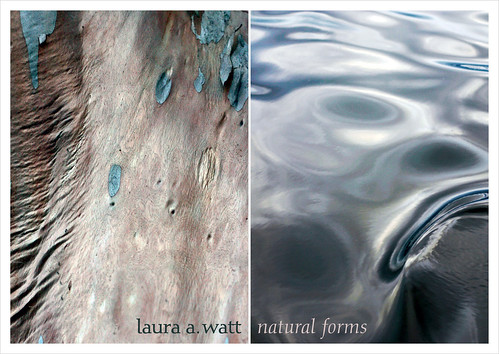
Flyer for Laura A. Watt's Natural Forms show

Don’t miss the Natural Forms show by one of my favorite Flickr photographers, Laura A. Watt’s. Her work is beautiful, subtle, and will take you someplace else if you let it. If you’re going to be in the Berkeley area this August, make a point of going!

Water, leaves, and other natural forms come together in Laura A. Watt’s Photos, straddling a fine line between straight representation and abstraction. Her fascination with curcing wave-shapes and subtle tones spans from vast skyscapes to tiny botanicals, with water flowing throughout.

The show runs at The Claremont Club, 41 Tunnel Rd., Berkeley, CA, US from 1–30 August, 2006.

ISO 24,000 film is not to be

In May, I re-posted Oran Grad’s post from The Online Photographer about a high-speed, ISO 24,000 black and white reversal (slide) film that Kodak’s research department came up with and was quite excited about its implications for pinhole and zone plate photography. Unfortunately, it appears that there wasn’t enough interest and they will not be offering the film commercially.

I received this from them via email:

The purpose of Dr. Gilman’s presentation, "A High-Speed Direct Positive Photothermographic System", was to share information on an innovative technology and to showcase its potential. Eastman Kodak Company invents and evaluates many technologies annually for possible commercial applications. However, Kodak does not have any plans to make this technology available in a commercial product.

I guess it’s time to start pushing the hell out of ISO 3200 film. I’ve successfully pushed Kodak T-MAX 3200 (TMZ) to 12800 using T-MAX developer and will see if I can coax another stop out of it or Delta 3200 to achieve the equivalent speed and report back with the results. It’ll be a negative instead of a positive and will have boulder-sized grain, but I’m still really excited about the prospect of handheld, freeze-frame, normal shutter speed pinhole photography.

More thoughts on the Jill Greenberg controversy at Hawk’s Digital Connection

Ok, so it seems like the heat is turning up on this Jill Greenberg controversy stuff. You remember Jill. The woman who takes photos of the emotionally wrenched kids in the name of art against the Bush administration (I think)…

From Hawk’s previous post on the subject:

So what is Jill Greenberg doing? She is taking babies, toddlers under three years old, stripping them of their clothes and then provoking them to various states of emotional distress, anger, rage etc. — so that she can then take photos of them this way to "illustrate her personal beliefs." If you’d like to see how worked up she can get these kids you can click through here. Be warned that it is graphic. Although the children are not sexualized, I consider what she is doing child pornography of the worst kind.

Continue reading at Thomas Hawk’s Digital Connection

After looking at the photos, I agree.

How can I have a problem with this and not with Witkin (NSFW)? Easy: informed consent. It differentiates sex from rape, boxing from assault, and DNR orders from murder… an important concept, to be sure. Witkin’s models know what they’re getting into and freely choose it. With kids of this age, there’s no way to make a legal or moral argument that they’ve been informed or have consented—that’s what makes it abuse.

I’m a big believer in fighting ideas rather than people, but in this case, I can’t pretend that I don’t think that Jill Greenberg—personally, not just her methods—is a reprehensible piece of shit. And where the fuck were these kids’ parents?? I sincerely hope that every one of the subjects finds a way to sue the ever-loving fuck out of everyone involved in this shameful affair.

New large format P&S cameras

Oren Grad writes at The Online Photographer:

Check out the re-launched, much improved website of Fotoman Camera. This Hong Kong-based company is known for its well-made, (relatively) inexpensive, interchangeable lens, scale focusing, roll film panorama cameras in 6×12, 6×17 and 6×24 formats. A long-awaited second lineup of large format point-and-shoot cameras has now finally become available, including an ultralight 4×5, an 8×10 and—surprise!—a 4×10 panoramic P&S. Helical focus mounts, viewfinders, a comprehensive selection of regular and panoramic viewfinder masks and a dual-axis bubble level are now offered separately as well for users who would like to mix-and-match with their own equipment.

They actually are relatively reasonably priced. I’m not quite sure when $699 US because "reasonable" for a metal spacer with lens and film holder mounts, but it is compared to what else is out there (typically $1500 and up(!)). By Grapthar’s hammer… what a savings.

Check them out at Fotoman Camera